If you’ve ever opened RoyaleAPI, watched a top Clash Royale YouTuber, or seen a pro player go 12-0 in a Grand Challenge, you’ve probably had the same thought:
“If I copy their deck, I’ll start winning too.”
I used to think exactly the same way.
Table of Contents
Years ago, every time I saw a top ladder player dominating with a deck, I would immediately copy it and jump into battles. If they could go 12 wins in a Grand Challenge without losing, surely I could win a few games with the same deck, right?
Wrong.
Most of the time, I actually performed worse.
Today, after reaching 14,000 trophies, achieving Ultimate Champion, completing the legendary 20 Win Challenge, winning multiple Grand Challenges, and helping 500+ Clash Royale players through SuperClashCN, I can confidently say this:
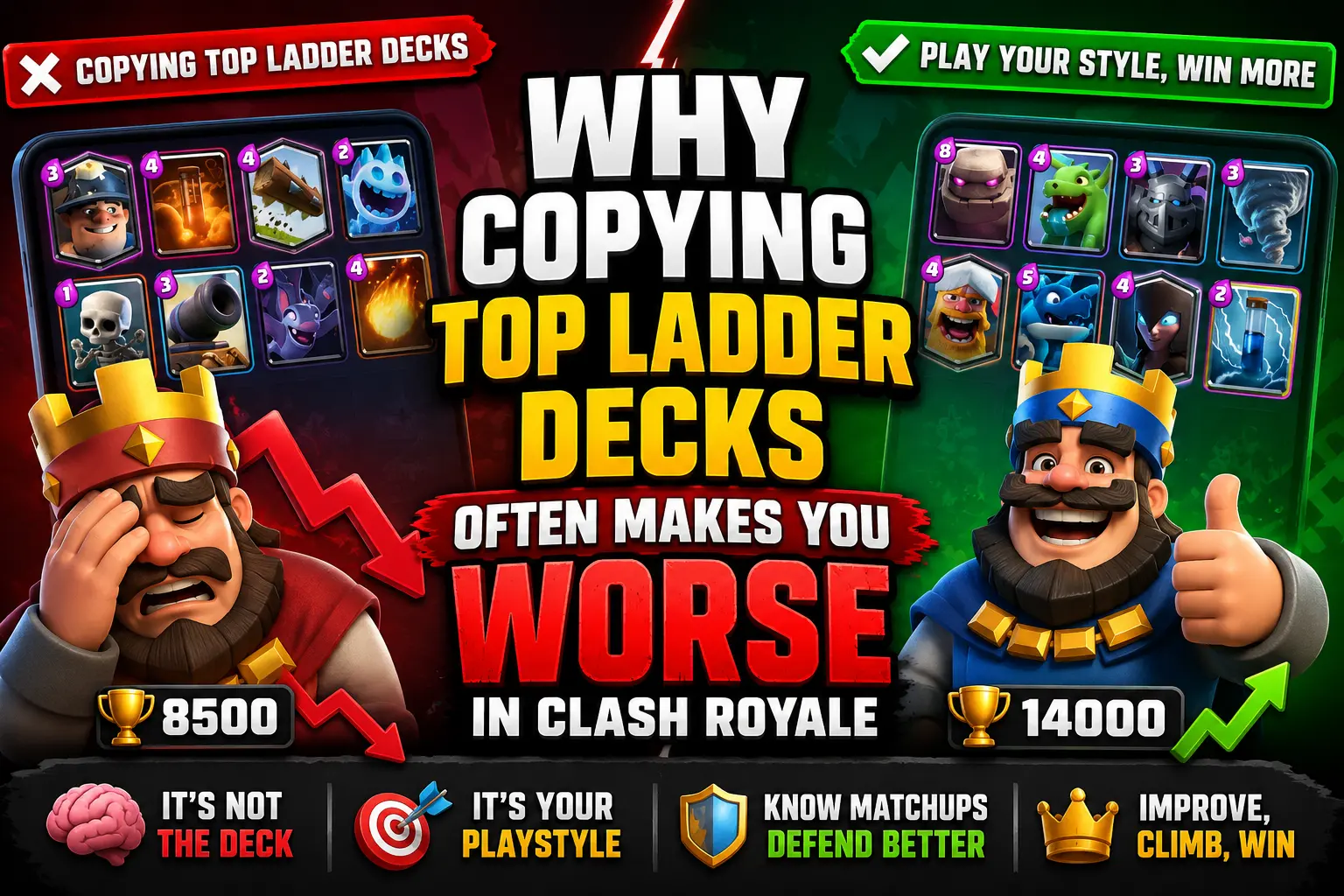
Copying a top ladder deck without understanding why it works will often make you lose more games, not win more.
Let’s talk about why.
The Deck Isn’t Carrying the Player
One of the biggest misconceptions in Clash Royale is that the deck is responsible for most of a player’s success.
Many players see a pro player using Miner Poison, Hog Cycle, or another popular meta deck and assume:
“This deck must be broken.”
But what they’re really seeing is years of experience in action.
Top ladder players know:
- Every common matchup
- Most card cycles by memory
- When to sacrifice tower damage
- When to defend and when to attack
- How to track elixir efficiently
- How to punish even the smallest mistakes
The deck isn’t carrying the player.
The player is carrying the deck.
That’s an important difference.
Why Top Ladder and Mid Ladder Are Completely Different Games
This is something most Clash Royale creators never explain.
A player in the global Top 1000 is playing a completely different game compared to someone in Master I, Master II, or around 8,000 to 10,000 trophies.
Top ladder players often face:
- Predictable meta decks
- Experienced opponents
- Optimized card levels
- Familiar archetypes
Meanwhile, mid ladder players face:
- Random deck combinations
- Overleveled cards
- Unusual card substitutions
- Players who don’t follow the meta at all
For example, a top ladder player may know there’s a high chance they’re facing a specific meta deck.
A player at 9,000 trophies might face:
- Mega Knight Balloon
- Hog Rider with Lightning
- Sparky Goblin Giant
- Elite Barbarians Rage
- A completely random homemade deck
All within five matches.
The strategies that work consistently at top ladder don’t always work in these environments.
That’s one of the biggest reasons copied decks often fail.
My Personal Experience With Copying Pro Decks
When I first started improving in Clash Royale, I constantly copied decks from RoyaleAPI and professional players.
Whenever I saw a deck performing well, I would instantly try it.
Most of the time, I failed.
The decks I struggled with the most were fast cycle decks.
Especially:
- Miner Poison
- Miner Wall Breakers
- Other low-cost cycle archetypes
At the time, I thought the deck was the problem.
Now I realize the problem was my playstyle.
I enjoy decks like:
- PEKKA Bridge Spam
- Golem
- Giant Beatdown
- Sparky
These decks focus more on building strong pushes, creating pressure, and making larger strategic decisions.
Cycle decks require a completely different skill set.
You need:
- Precise defense
- Fast decision-making
- Excellent card cycling
- Patience
- Consistent chip damage
I wasn’t losing because the deck was bad.
I was losing because the deck didn’t match my strengths.
The Hardest Deck Archetypes to Copy Successfully
Not every deck is equally difficult to learn.
Some decks are extremely unforgiving.
1. Miner Poison
In my opinion, Miner Poison is one of the hardest archetypes in Clash Royale.
Many players see small amounts of chip damage and think:
“That’s easy.”
It’s not.
The entire deck depends on:
- Perfect defense
- Positive elixir trades
- Matchup knowledge
- Patience
One defensive mistake can cost the entire game.
2. Miner Wall Breakers
Another archetype that looks easy but isn’t.
You need to constantly pressure opponents while defending efficiently.
Most average players struggle to maintain that balance.
3. Hog Cycle Variants
Cycle decks punish mistakes immediately.
A single bad card placement can create a huge disadvantage.
4. X-Bow
X-Bow is one of the most matchup-dependent archetypes in the game.
Without deep understanding, it can feel impossible to play consistently.
Easier Deck Archetypes for Average Players
“Easier” doesn’t mean stronger.
It simply means the learning curve is less steep.
Golem
One of the simplest archetypes to understand.
You defend, build elixir, and create a massive push.
Giant
Straightforward win condition with clear objectives.
LavaLoon
The game plan is easy to understand, even if mastering it takes time.
Sparky
Most players can quickly understand how the deck wants to win.
These archetypes often allow players to focus on larger strategic decisions instead of dozens of tiny micro-interactions.
Signs You Don’t Actually Understand Your Deck
Many players think they know their deck.
Then they make the same mistakes every game.
Here are some warning signs.
You Overcommit on Offense
You spend too much elixir trying to force damage.
Then you can’t defend the counterpush.
You Waste Key Defensive Cards
Using an important defensive card at the wrong time can instantly lose a match.
You Panic Cycle
Instead of having a plan, you’re simply placing cards because you don’t know what else to do.
You Can’t Defend Efficiently
One of the biggest differences between average players and great players is defensive efficiency.
You Don’t Know Your Opponent’s Deck
By the middle of a match, you should already have a strong idea of what archetype your opponent is playing.
If you don’t, you’re giving away a major advantage.
How I Learn a New Deck
One of the biggest mistakes players make is judging a deck too quickly.
They play ten matches.
Lose six.
Then declare the deck bad.
That’s not enough.
My process is simple.
Step 1: Play At Least 50-100 Games
Before judging a deck, I want to understand:
- Card interactions
- Defensive options
- Offensive opportunities
- Matchup patterns
Step 2: Learn Every Card’s Role
Every card exists for a reason.
You should know:
- What it counters
- What it struggles against
- When to save it
Step 3: Learn Defensive Interactions
Most games are won through defense first.
Strong defense creates strong counterpushes.
Step 4: Test Yourself in Classic Challenges
Classic Challenges are one of the best ways to measure actual improvement.
Step 5: Evaluate After Facing Good Players
Once you reach around 8 or 9 wins in a Classic Challenge, the competition becomes much stronger.
That’s where you’ll discover whether you’ve truly learned the deck.
The Smarter Way to Copy Top Ladder Decks
I still believe players should learn from top ladder.
The problem isn’t copying.
The problem is copying blindly.
Here’s a better approach.
If you play:
- PEKKA Bridge Spam → Copy another PEKKA deck.
- Golem → Copy another Golem deck.
- Giant → Copy another Giant deck.
- Sparky → Copy another Sparky deck.
Stay within archetypes you already understand.
Making small adjustments is much easier than completely changing your playstyle.
A PEKKA player doesn’t suddenly become a Miner Poison expert overnight.
What Most Players Actually Need
Many players think they need:
- A better deck
- A stronger meta deck
- A deck used by a pro player
In reality, they often need:
- Better defense
- Better matchup knowledge
- Better elixir management
- Better understanding of their current deck
The truth is simple.
Most players don’t need a new deck.
They need more experience with the deck they already have.
Final Thoughts
After reaching 14,000 trophies, achieving Ultimate Champion, completing the 20 Win Challenge, winning multiple Grand Challenges, and helping more than 500 Clash Royale players through SuperClashCN, I’ve learned one important lesson:
The strongest deck in Clash Royale isn’t always the best deck for you.
The best deck is the one you understand better than your opponents.
Before copying the latest top ladder deck, ask yourself:
“Do I actually need a new deck, or do I simply need more practice with the one I’m already using?”
The answer to that question will probably improve your Clash Royale results more than any deck copy button ever will. 🎯👑
Superclashcn
Dominate the arena
Dominate Clash Royale with SuperClashCN! Achieve your dream Trophies, Rank, & Challenge wins. Fast, safe, & guaranteed boosts by pro players. #ClashRoyale